
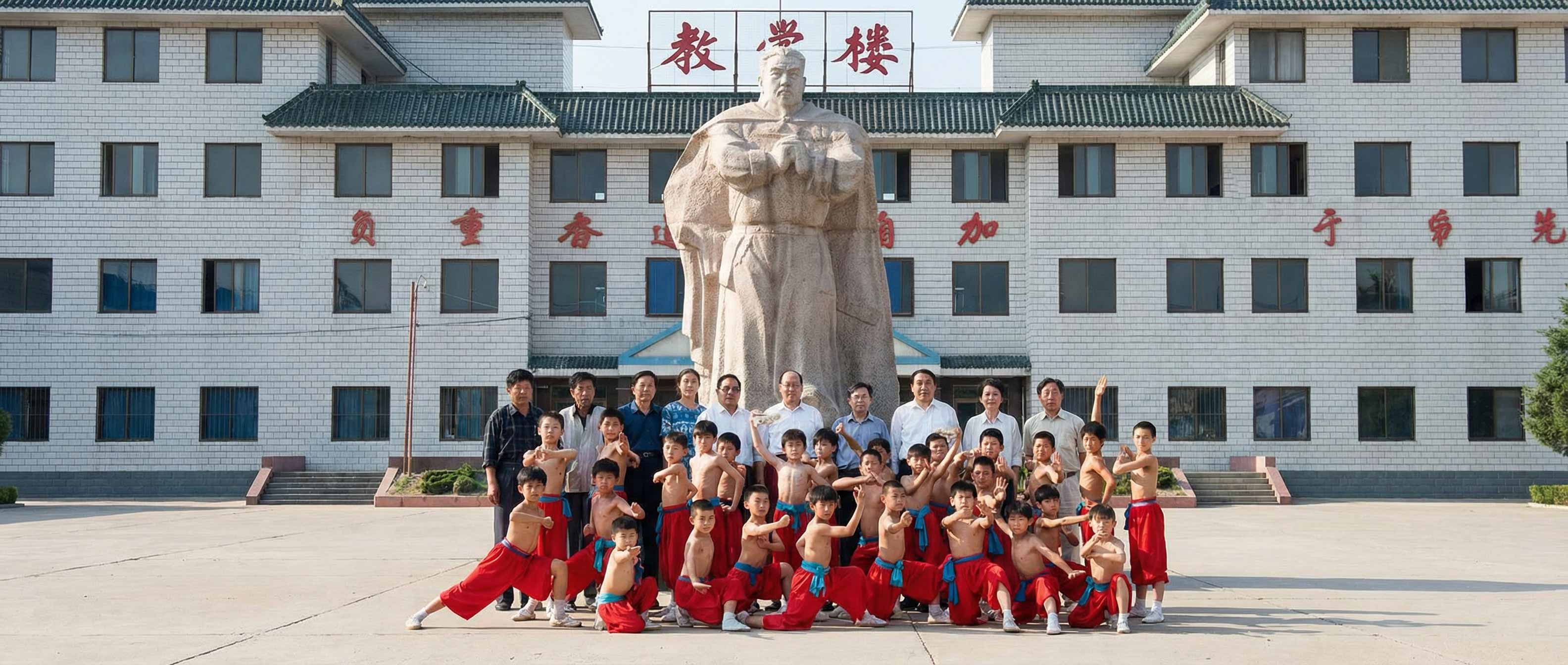
If you want to take your wushu to the next level, there’s nothing quite like training in China. My choice was Song Jiang Wushu School in Yuncheng, Shandong. I spent four years there—and loved every second of it.
Here’s why Song Jiang was the perfect choice for me. If you’re planning a similar adventure, I hope this helps.
I knew I had to find a Chinese wushu school with little to no experience with foreigners. I didn’t want to pay tourist prices, and I didn’t want special treatment. My goal was to train in regular classes alongside Chinese students — I knew that was the only way I could reach their level.
At Song Jiang, they were just starting to form a foreign exchange program, but I managed to navigate around it.
To make real progress, I had to remove every escape hatch. No other foreigners to talk to. No distractions. No falling back on German or English.
At the time, Song Jiang had around 4,000 Chinese students — and zero other foreigners.
Exactly what I was looking for.
Yuncheng had about 1.2 million people, but it felt more like a giant village. Most locals had never seen a foreigner before — except on TV.
When I arrived, the city basically had one tourist sight: a small tower near a lake. Later, Song Jiang built a small wushu museum using relocated temples, which was actually pretty cool. These days, they even shoot movies there from time to time.
I wasn’t a rich kid. Even if I’d wanted to study in a big city or attend a famous institute, I simply couldn’t afford it. At Song Jiang, I ate sitting on the floor with the other kids and trained in standard classes.
I originally planned to sleep in a dorm with twelve Chinese students, but the headmaster didn’t allow it — so I was forced to spend a few extra dollars on a better room and ended up with my own private shower. Most Chinese students could only shower once a week.
I considered Beijing Sport University at first — but decided against it for four main reasons:
In China, students usually enter sports universities only after they’ve already become elite athletes. Wushu there is secondary to academics. Yes, the techniques are polished — but foreigners aren’t expected to reach the same level as Chinese students.
You’re expected to learn wushu history, rules, and culture. They treat you as if you’re going to become an ambassador for the sport.
At normal schools, you’re expected to perform. You’re treated like an idiot if you can’t do the jumps. And if that pushed me to train harder, I preferred that.
Song Jiang is not a monastery. If you’re looking for something spiritual, you’d be better off at mountain schools in Henan or the Wudang Mountains.
I wanted modern competitive wushu — jumps, power, performance.
Sure, you can learn that at Tagou Shaolin Wushu School. But again, foreigners there are usually separated from Chinese students. I’ve heard of a few attending regular classes too — but it’s still more expensive, and there are still more distractions.
Yes. Absolutely.
If you want to train in regular classes, start learning Chinese as early as possible. Teachers won’t slow down class for a translator. For them, forming athletes is personal — it reflects directly on their own performance.
When you train with a Chinese coach, the same rules apply to you as everyone else. You have to earn their respect.
At first, you just try to keep up. Sometimes you’ll get one-on-one corrections from a six-year-old while you’re sick or injured. But instructions are always for the whole class.
How much does it cost to train wushu in China?
It depends on the school, city, and living conditions. Smaller cities and smaller schools are dramatically cheaper than big programs in Beijing, Shanghai, or Dengfeng — especially when it comes to food and accommodation.
Back then, I spent about $100 per month on school fees and roughly $150 more on accommodation and food. That was a while ago, so I’d expect costs to be about double now.
Can foreigners train with Chinese students?
At most schools, foreigners are separated.
Song Jiang allowed me to train in regular Chinese classes. If that’s something you want, you need to be very clear about it before committing to any wushu school in China.
Do I need to speak Chinese to train?
If you want real progress — yes.
If you plan to stay longer than just a few weeks or months, 100% yes. Coaches don’t like talking to translators during class. Basic Mandarin is essential.
How long should you train in China?
If you train with Chinese students, progress will be slow — but very real. You won’t just learn a thousand forms; you’ll get a thousand times better at the basics.
I recommend at least three months — ideally, years.
Is Song Jiang good for beginners?
Yes — but only if you’re ready for discipline. You won’t be coddled.
Is Song Jiang good for traditional styles?
They do teach traditional styles—at least when I was there—but it isn’t the school’s main focus. If you’re specifically looking for Bagua or hoping to study under a traditional grandmaster, this probably isn’t the place for that. However, they’re extremely well connected and can often invite masters for private lessons—just make sure you let them know before you walk through the gate.
Like most Chinese wushu schools, you’ll usually find someone who can teach praying mantis, ditang, drunken style, taiji, and some traditional weapons. The difference is that these styles aren’t what students train year-round. The core focus is modern wushu. Traditional material is typically practiced during lighter training phases, vacations, or recovery periods after injuries.
